Why the Future Doesn't Need Us

To complete your fifth essay, please write a three- to five-page (600-900 word) response to the following question:
In “Final Jeopardy” (pp. 234-242), Stephen Baker expresses an interesting look at the way technology, especially in terms of machines, could dramatically change the relationship between mankind and technology—not just helping us to locate information, but also to show us how to think about it. What are Baker’s concerns about this evolution in technology, and what are his reasons (stated or implied) for optimism? As you consider the relative strengths and weaknesses of those reasons, explain whether and why you find yourself more pessimistic or more optimistic about our changing technologies as presented by Baker.
Please ensure that your essay addresses each component of the question assigned question and that your answer is well- organized, uses excellent, college-level prose, and makes judicious use of textual evidence.

Annotated Bibliography

In an annotated bibliography, you follow each of your reference citations with a brief (100 words or less) qualification of the author (including their relevance to the subject); intended audience; how the source compares/contrasts with your other sources; how this source furthers the discussion of the selected topic.
This week’s assignment will be included in your rough draft (due in week 6).
Step 1:
For this exercise, find sources that are relevant to your researched argument paper. You must have five or more annotations in your bibliography. The sources must be scholarly sources. These types of sources (also identified as academic or peer-reviewed sources) are written by recognized experts in a particular field. These sources provide credible information for use in research papers.
Step 2:
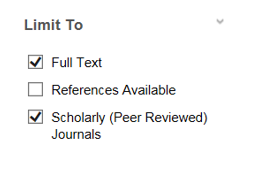
Refer to the Writing Guide for information on scholarly sources. EBSCOhost is a source for scholarly sources. Under the “Limit To” heading on the search page, you can narrow your search: https://content.grantham.edu/at/EN102_revJAN2017/EN102_ebsco_limit-to.PNG
Step 3:
Prepare your annotations as you read your sources. Use these questions as a guide for your notes: 1.Who is/are the author(s) and their relevance to the subject 2.Who is the intended audience; who is the author writing to (general public, researchers, academics, scientists?) 3.How this source relates or contrasts to at least one of our other sources 4.How this source helps to further your discussion of the topic
Step 4:
Checklist for Annotated Bibliography: •Does this bibliography meet the assignment criteria? •How does the formatting of this assignment look? Does it follow basic APA guidelines for a Reference page? (e.g. Times New Roman font, double-spaced, no extra spacing between paragraphs, first line of the citation flush left with all following lines indented, etc.?) •Are the annotations brief, clear, and informative? Do they avoid personal opinion? Do they act as a reference guide? •If you came upon this in your research, how useful would you find this bibliography to be? •Does this bibliography contain at least five citations?

Strategic Philanthropy for Organization

Strategic Philanthropy for Organizations” •Research a Fortune 500 company, but do not use the same company you used for the Week 1 “Social Responsibility” assignment. Examine the company’s strategic philanthropy and how it impacts profits, brand, image and turnover, as well as society as a whole. •Also, address any disadvantages or associated costs the company experiences as a result of its strategic philanthropy practices.
The requirements below must be met for your paper to be accepted and graded: •Write between 750 – 1,250 words (approximately 3 – 5 pages) using Microsoft Word in APA style, see example below. •Use font size 12 and 1” margins. •Include cover page and reference page. •At least 80% of your paper must be original content/writing. •No more than 20% of your content/information may come from references. •Use at least three references from outside the course material, one reference must be from EBSCOhost. Text book, lectures, and other materials in the course may be used, but are not counted toward the three reference requirement. •Cite all reference material (data, dates, graphs, quotes, paraphrased words, values, etc.) in the paper and list on a reference page in APA style.
References must come from sources such as, scholarly journals found in EBSCOhost, CNN, online newspapers such as, The Wall Street Journal, government websites, etc. Sources such as, Wikis, Yahoo Answers, eHow, blogs, etc. are not acceptable for academic writing.

government regulation of businesses

1. List and briefly describe (in your own words) the three main reasons for government regulation of businesses. 2. List and describe (in your own words) the six principles for organizations to become an Employer of Choice. 3. List and describe (in your own words) three of the crucial keys to development of an effective ethics program. 4. List and explain (in your own words) the benefits of government regulation of business. 5. List the six rights of the consumer and explain (in your own words) why each one is important. 6. Explain why you think consumer protection laws are effective or ineffective. 7. Explain social responsibility in your own words. 8. Describe (in your own words) two advantages and two disadvantages of business regulations.

Project Mng.

Assignment 1: Assess Organizational Readiness
Note: The assignments are a series of papers that are based on the same case, which is located in the Student Center of the course shell. The assignments are dependent upon one another.
Review the assigned case study and complete this assignment.
Write a five to seven (5-7) page paper in which you: 1.Analyze how the Critical Success Factors (CSFs) apply to the facts of the case study. Provide examples to support your analysis. 2.Determine the project benefits, organizational readiness, and risk culture of the company in the case study. Provide justification for your response. 3.Develop at least three (3) project risk recommendations based on the analysis from criteria number 1 and 2 of this assignment. 4.Identify the initial categories of risk (RBS Level 1 and 2) that you see as being present in the case study using the Example Risk Checklist (Figure A-2, Hillson & Simon text). 5.Use at least four (4) quality resources in this assignment. Note: Wikipedia and similar Websites do not qualify as quality resources.
Your assignment must follow these formatting requirements: •Be typed, double spaced, using Times New Roman font (size 12), with one-inch margins on all sides. •Include a cover page containing the title of the assignment, the student’s name, the professor’s name, the course title, and the date. The cover page and the reference page are not included in the required assignment page length.
The specific course learning outcomes associated with this assignment are: •Analyze the critical success factors (CSFs), project benefits, and organizational readiness and risk culture of the company. •Apply the results of this analysis to the development of project risk recommendations. •Use technology and information resources to research issues in project risk management •Write clearly and concisely about project risk management using proper writing mechanics. writing skills, using the following rubric.
Points: 200
Assignment 1: Assess Organizational Readiness
Criteria
Unacceptable
Below 70% F
Fair
70-79% C
Proficient
80-89% B
Exemplary
90-100% A
1. Analyze how the Critical Success Factors (CSFs) apply to the facts of the case study. Provide examples to support your analysis.
Weight: 20%
Did not submit or incompletely analyzed how the Critical Success Factors (CSFs) apply to the facts of the case study. Did not submit or incompletely provided examples to support your analysis.
Partially analyzed how the Critical Success Factors (CSFs) apply to the facts of the case study. Partially provided examples to support your analysis.
Satisfactorily analyzed how the Critical Success Factors (CSFs) apply to the facts of the case study. Satisfactorily provided examples to support your analysis.
Thoroughly analyzed how the Critical Success Factors (CSFs) apply to the facts of the case study. Thoroughly provided examples to support your analysis.
2. Determine the project benefits, organizational readiness, and risk culture of the company in the case study. Provide justification for your response. Weight: 25%
Did not submit or incompletely determined the project benefits, organizational readiness, and risk culture of the company in the case study. Did not submit or incompletely provided justification for your response.
Partially determined the project benefits, organizational readiness, and risk culture of the company in the case study. Partially provided justification for your response.
Satisfactorily determined the project benefits, organizational readiness, and risk culture of the company in the case study. Satisfactorily provided justification for your response.
Thoroughly determined the project benefits, organizational readiness, and risk culture of the company in the case study. Thoroughly provided justification for your response.
3. Develop at least three (3) project risk recommendations based on the analysis from criteria number 1 and 2 of this assignment.
Weight: 20%
Did not submit or incompletely developed at least three (3) project risk recommendations based on the analysis from criteria number 1 and 2 of this assignment.
Partially developed at least three (3) project risk recommendations based on the analysis from criteria number 1 and 2 of this assignment.
Satisfactorily developed at least three (3) project risk recommendations based on the analysis from criteria number 1 and 2 of this assignment.
Thoroughly developed at least three (3) project risk recommendations based on the analysis from criteria number 1 and 2 of this assignment.
4. Identify the initial categories of risk (RBS Level 1 and 2) that you see as being present in the case study using the Example Risk Checklist (Figure A-2, Hillson & Simon text).
Weight: 20%
Did not submit or incompletely identified the initial categories of risk (RBS Level 1 and 2) that you see as being present in the case study using the Example Risk Checklist (Figure A-2, Hillson & Simon text).
Partially identified the initial categories of risk (RBS Level 1 and 2) that you see as being present in the case study using the Example Risk Checklist (Figure A-2, Hillson & Simon text).
Satisfactorily identified the initial categories of risk (RBS Level 1 and 2) that you see as being present in the case study using the Example Risk Checklist (Figure A-2, Hillson & Simon text).
Thoroughly identified the initial categories of risk (RBS Level 1 and 2) that you see as being present in the case study using the Example Risk Checklist (Figure A-2, Hillson & Simon text).
5. 4 references
Weight: 5%
No references provided
Does not meet the required number of references; some or all references poor quality choices.
Meets number of required references; all references high quality choices.
Exceeds number of required references; all references high quality choices.

Law and ethics

Assignment 1: Facebook Live Killings Due Week 4 and worth 280 points
Read the article Cleveland Shooting Highlight’s Facebook’s Responsibility in Policing Depraved Videos found at: http://www.nbcnews.com/tech/social-media/cleveland-shooting-highlights-facebook-s-responsibility-policing-depraved-videos-n747306
Write a four to five (4-5) page paper in which you: 1.Discuss whether or not you believe that Facebook has a legal or ethical duty to rescue a crime victim. 2.Suggest and elaborate on three (3) ways that social media platforms can be more proactive and thorough with their review of the types of content that appear on their sites. 3.Propose two (2) safeguards that Facebook and other social media platforms should put into place to help prevent acts of violence from being broadcasted. 4.Conduct some research to determine whether or not Facebook has an Ethics Officer or Oversight Committee. If so, discuss the key functions of these positions. If not, debate on whether or not they should create these roles. 5.Propose two (2) changes Facebook should adopt to encourage ethical use of their platform. 6.Use at least two (2) quality resources in this assignment. Note: Wikipedia is not an acceptable reference and proprietary Websites do not qualify as academic resources.
Your assignment must follow these formatting requirements: •Be typed, double spaced, using Times New Roman font (size 12), with one-inch margins on all sides; citations and references must follow APA or school-specific format. Check with your professor for any additional instructions. •Include a cover page containing the title of the assignment, the student’s name, the professor’s name, the course title, and the date. The cover page and the reference page are not included in the required assignment page length.
The specific course learning outcomes associated with this assignment are: •Analyze and apply the concepts of ethical decision making, corporate governance and corporate social responsibility •Use technology and information resources to research issues in law, ethics, and corporate governance. •Write clearly and concisely about law, ethics, and corporate governance using proper writing mechanics. and writing skills, using the following rubric.
Points: 280 Assignment 1: Facebook Live Killings
Criteria
Unacceptable Below 70% F
Fair 70-79% C
Proficient 80-89% B
Exemplary 90-100% A
1. Discuss whether or not you believe that Facebook has a legal or ethical duty to rescue a crime victim. Weight: 15%
Did not submit or incompletely discussed whether or not you believe that Facebook has a legal or ethical duty to rescue a crime victim.
Partially discussed whether or not you believe that Facebook has a legal or ethical duty to rescue a crime victim.
Satisfactorily discussed whether or not you believe that Facebook has a legal or ethical duty to rescue a crime victim.
Thoroughly discussed whether or not you believe that Facebook has a legal or ethical duty to rescue a crime victim.
2. Suggest and elaborate on three (3) ways that social media platforms can be more proactive and thorough with their review of the types of content that appear on their sites.. Weight: 20%
Did not submit or incompletely suggested and elaborated on three (3) ways that social media platforms can be more proactive and thorough with their review of the types of content that appear on their sites.
Partially suggested and elaborated on three (3) ways that social media platforms can be more proactive and thorough with their review of the types of content that appear on their sites.
Satisfactorily suggested and elaborated on three (3) ways that social media platforms can be more proactive and thorough with their review of the types of content that appear on their sites.
Thoroughly suggested and elaborated on three (3) ways that social media platforms can be more proactive and thorough with their review of the types of content that appear on their sites.
3. Propose two (2) safeguards that Facebook and other social media platforms should put into place to help prevent acts of violence from being broadcasted. Weight: 20%
Did not submit or incompletely proposed two (2) safeguards that Facebook and other social media platforms should put into place to help prevent acts of violence from being broadcasted.
Partially proposed two (2) safeguards that Facebook and other social media platforms should put into place to help prevent acts of violence from being broadcasted.
Satisfactorily proposed two (2) safeguards that Facebook and other social media platforms should put into place to help prevent acts of violence from being broadcasted.
Thoroughly proposed two (2) safeguards that Facebook and other social media platforms should put into place to help prevent acts of violence from being broadcasted.
4. Conduct some research to determine whether or not Facebook has an Ethics Officer or Oversight Committee. If so, discuss the key functions of these positions. If not, debate on whether or not they should create these roles. Weight: 15%
Did not submit or incompletely determined whether or not Facebook has an Ethics Officer or Oversight Committee. If so, they did not submit or incompletely discussed the key functions of these positions. If not, they did not submit or incompletely debated on whether or not they should create these roles.
Partially determined whether or not Facebook has an Ethics Officer or Oversight Committee. If so, they partially discussed the key functions of these positions. If not, they partially debated on whether or not they should create these roles.
Satisfactorily determined whether or not Facebook has an Ethics Officer or Oversight Committee. If so, they satisfactorily discussed the key functions of these positions. If not, they satisfactorily debated on whether or not they should create these roles.
Thoroughly determined whether or not Facebook has an Ethics Officer or Oversight Committee. If so, they thoroughly discussed the key functions of these positions. If not, they thoroughly debated on whether or not they should create these roles.
5. Propose two (2) changes Facebook should adopt to encourage ethical use of their platform. Weight: 15%
Did not submit or incompletely proposed two (2) changes Facebook should adopt to encourage ethical use of their platform.
Partially proposed two (2) changes Facebook should adopt to encourage ethical use of their platform.
Satisfactorily proposed two (2) changes Facebook should adopt to encourage ethical use of their platform.
Thoroughly proposed two (2) changes Facebook should adopt to encourage ethical use of their platform.
6. 2 references Weight: 5%
No references provided

Statistics

1. The manager of a computer help desk operation has collected enough data to conclude that the distribution of time per call is normally distributed with a mean equal to 8.21 minutes and a standard deviation of 2.14 minutes. The manager has decided to have a signal system attached to the phone so that after a certain period of time, a sound will occur on his employees’ phone if he exceeds the time limit. The manager wants to set the time limit at a level such that it will sound on only 8 percent of all calls. What is the time limit should be?